Cold . The pairing
What to drink with hot wings
The standard advice is milk. The standard advice is half right, and for hot wings specifically it's mostly wrong.
What is happening in your mouth
Capsaicin, the compound that makes chilli hot, isn't a flavour. It binds to TRPV1, a receptor that normally detects actual heat: temperatures above roughly 109°F. Capsaicin activates it chemically, so your nervous system reports burning in the complete absence of anything hot.
Two consequences follow, and they explain everything about what works.
First, capsaicin is fat-soluble and not water-soluble. Water moves it around your mouth rather than removing it, which is why a glass of water makes things briefly worse.
Second, because the receptor responds to real temperature too, cold physically calms it. Cold isn't masking the sensation; it's acting directly on the same receptor from the opposite direction.
Where milk comes from, and why beer still wins
Milk works for a real reason. Casein, the dominant protein in dairy, is lipophilic . It surrounds capsaicin molecules and lifts them off the receptors, more or less the way detergent lifts grease. Full-fat milk works better than skimmed because the fat helps too.
So milk is the most effective capsaicin remover. It's also, at a table with a plate of wings, completely wrong . It coats the palate, it's heavy, it dulls everything you're about to eat, and after two glasses you're finished eating.
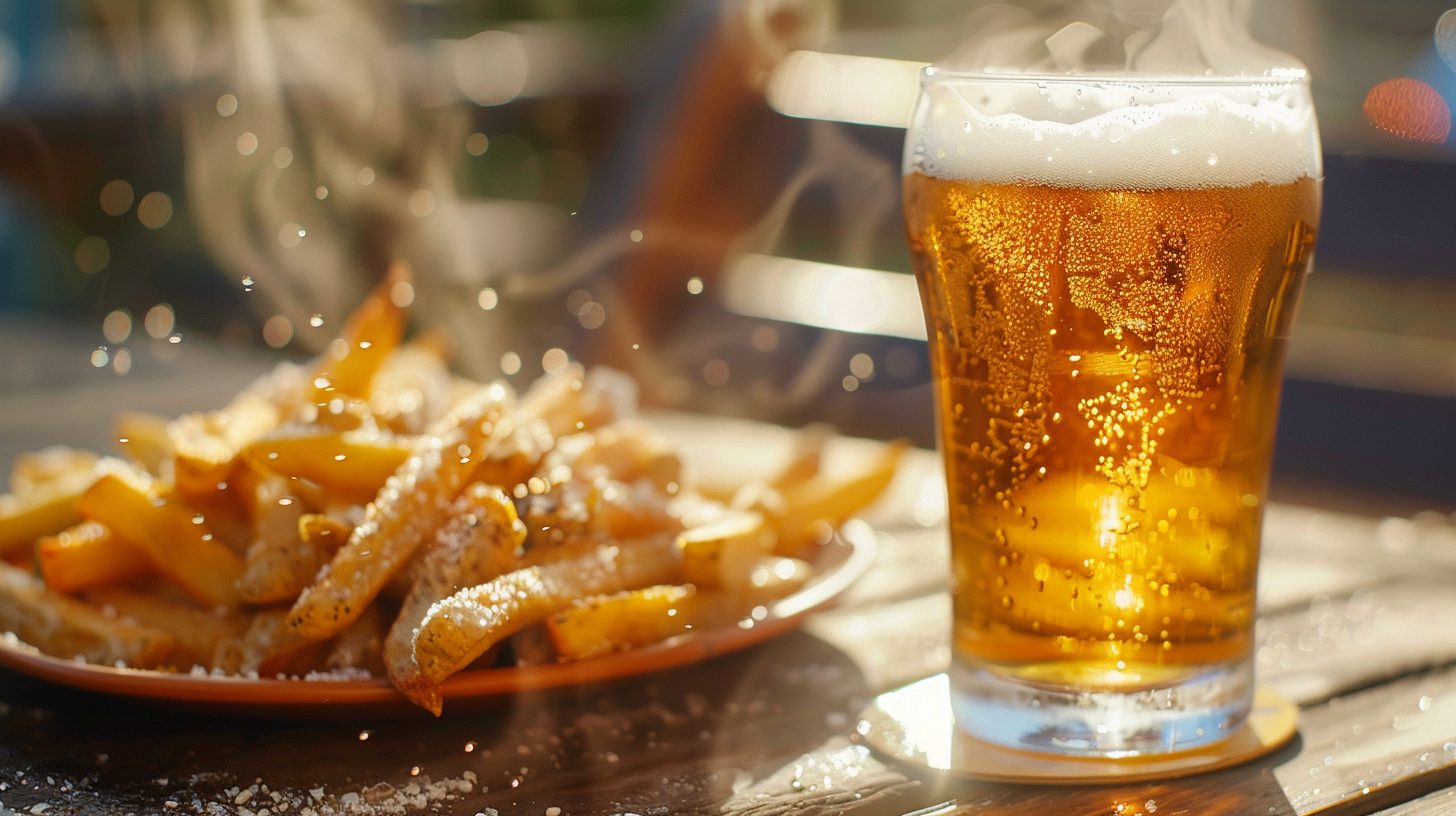
Beer does two of the three jobs, and does them without ending the meal. It's served cold, which quiets TRPV1 directly. It's carbonated, and carbonic acid provides a competing trigeminal sensation that partly distracts from the burn. And critically, its bitterness and acidity clear fat and salt off the palate so the next wing tastes like the first one.
Alcohol is a partial solvent for capsaicin, but at beer strength the effect is small. Don't reach for something stronger on that logic, high-proof spirits irritate the same receptor and make the burn worse.
What to order
The properties you want are: cold, well carbonated, low residual sweetness, moderate bitterness, and low alcohol. That describes a pilsner, a helles, a Mexican lager or a kolsch almost exactly.
Low alcohol matters more than people expect, because wings are a volume food. Six wings is three or four beers' worth of eating. A 4.5% lager lets you finish the plate. A 7.5% IPA doesn't.
What not to order
Hazy IPAs. The most common wrong answer, because hops and heat sound like they belong together. They don't. Bitterness and capsaicin are additive, the burn stacks rather than resolving, and hazy IPAs carry residual sweetness and body that coat rather than clear.
Anything heavy or sweet. Stouts, milkshake IPAs, pastry anything. Sugar plus capsaicin plus fat is three coating agents at once.
High-alcohol anything. Ethanol at strength is itself a trigeminal irritant.
The non-beer answers
A lassi or a horchata is the best-performing drink on the table by a distance, dairy or rice starch plus sugar plus cold, hitting every mechanism at once. There's a reason these exist alongside the world's spiciest cuisines rather than in spite of them.
Cold full-fat milk works and tastes like defeat. A high-acid drink like limeade helps meaningfully: the acid cuts fat, and the cold does its own work.
Something sweet and cold with dairy in it's the strongest option available, which is why ice cream after a very hot meal isn't a coincidence.
Buffalo sauce is already doing some of the work
Classic buffalo sauce is hot sauce cut with butter, and that butter isn't decoration. Fat dissolves capsaicin, so an emulsified sauce delivers a burn that's meaningfully rounder and shorter than the same hot sauce neat. A dry rub with the same nominal heat will hit harder and linger longer, because nothing is carrying the capsaicin away.
Two things that aren't true
Bread does nothing much. It absorbs a little sauce mechanically but doesn't remove capsaicin from receptors. The relief is brief.
Building tolerance is real, and it's receptor-level. Repeated exposure to capsaicin desensitises TRPV1 over time. People who eat spicy food regularly aren't being stoic . They are experiencing measurably less.
The short version
- Cold and carbonated beats strong and hoppy.
- Pilsner, helles, Mexican lager, kolsch. Under 5% if you plan to finish the plate.
- Skip the hazy IPA. Bitterness stacks with heat rather than cutting it.
- If the burn gets away from you, dairy is the real fix. Beer is the enjoyable one.
Cold & Crispy is a participant in the Amazon Services LLC Associates Program, an affiliate advertising program designed to provide a means for sites to earn advertising fees by advertising and linking to Amazon.com. As an Amazon Associate we earn from qualifying purchases. This doesn't affect what we recommend or what we say about it. This article explains the underlying physics and technique; it doesn't report original lab testing.